Feed Your Rabbits Right: 3 Basic Feeds for Better Growth, Breeding and Profit
One of the first things I learned about rabbit farming is that having plenty of feed does not always mean you are feeding rabbits properly.
You can have grass everywhere around the farm, buy good pellets, and even provide vegetables regularly, yet your rabbits may still grow slowly, develop digestive problems, or give you disappointing breeding results.
Why?
Because rabbit feeding is not just about filling the feeding trough. The type of feed, quality, quantity, freshness and consistency all matter.
I have seen farmers make the mistake of giving rabbits whatever green leaves they can find without knowing whether the leaves are suitable. Others depend heavily on expensive pellets because they believe pellets alone will make rabbits grow faster. Some provide plenty of fresh grass but very little dry roughage.
The good news is that you don’t need a complicated feeding system to raise healthy rabbits.
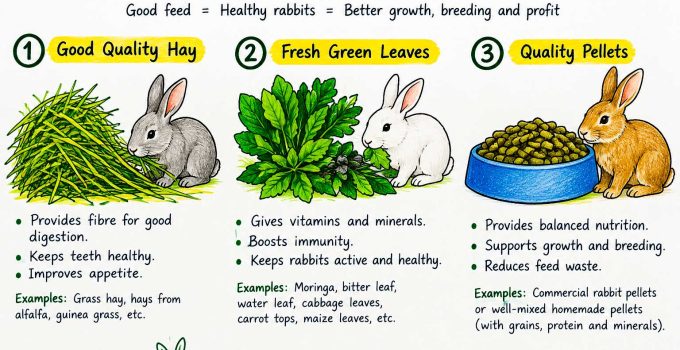
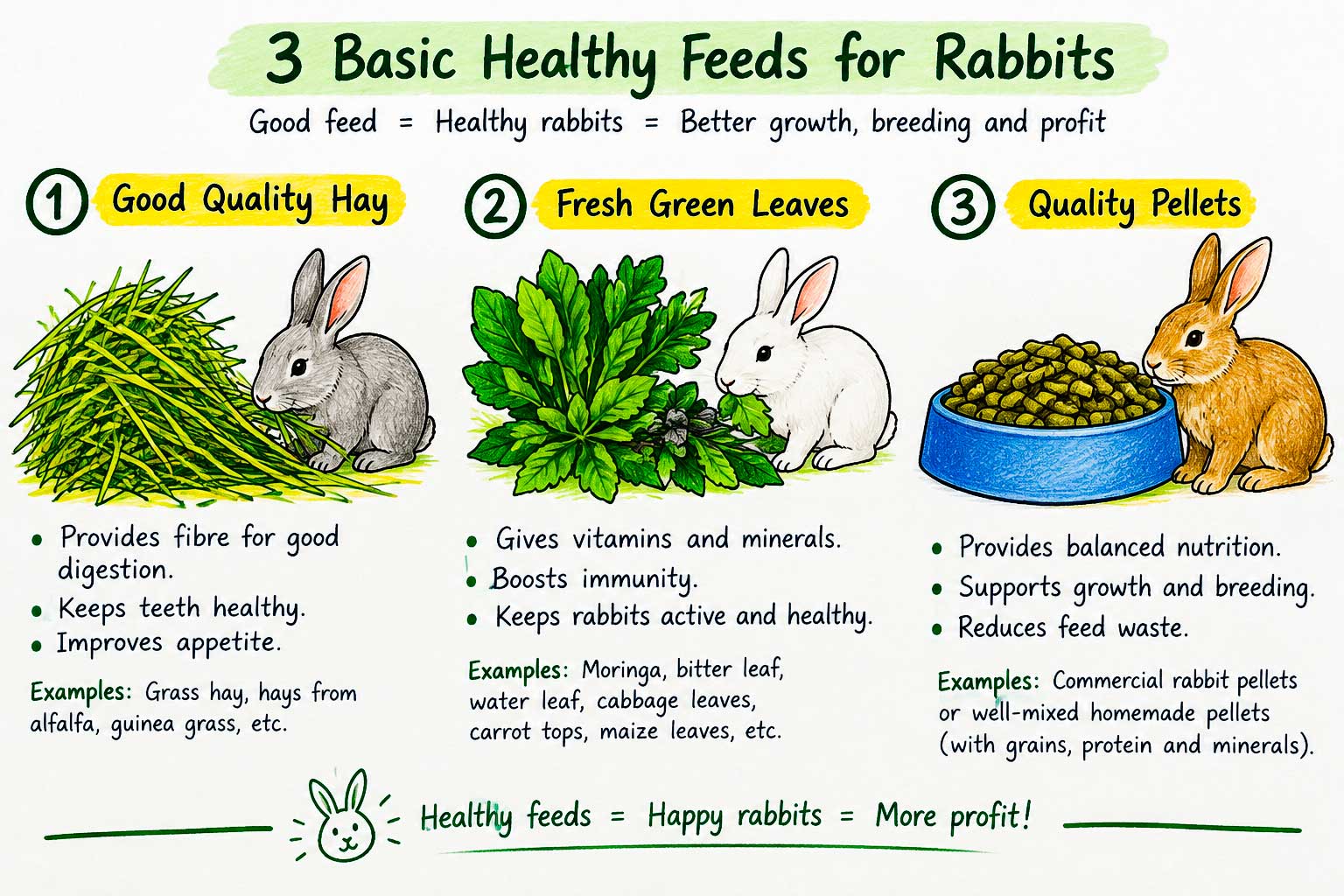
For most small and medium-scale farms, you can build a practical feeding programme around three basic feed groups: fresh forage, hay and pellets or other balanced concentrates.
Let us look at how each one works and how you can use them wisely.
-
Fresh Forage and Green Leaves
Fresh forage is one of the easiest and most affordable feeds available to many rabbit farmers.
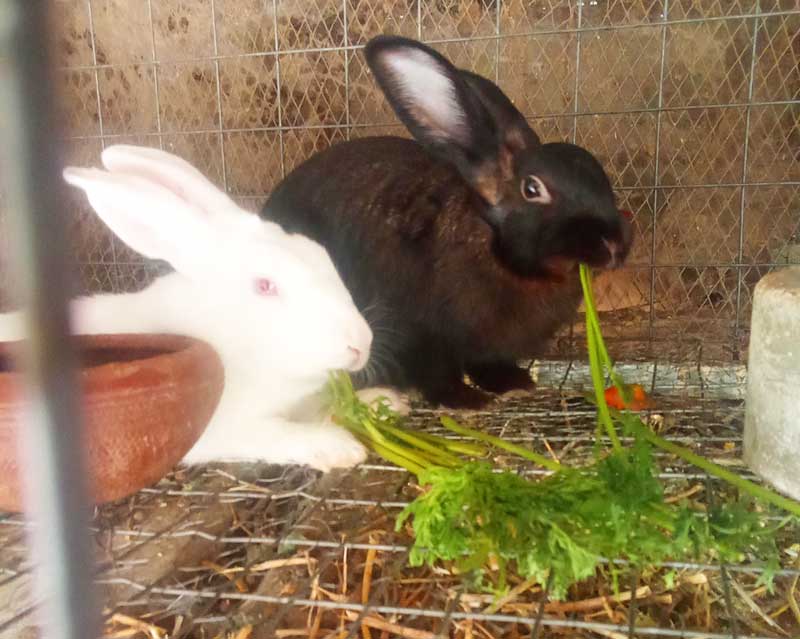
Depending on your location, suitable forage may include grasses and safe leafy plants such as Tridax, guinea grass, elephant grass, moringa leaves and other known rabbit-safe forage plants.
The important word here is safe.
Don’t assume that because a goat, sheep or cow can eat a particular plant, your rabbits should eat it too. Some plants can be harmful to rabbits.
Why fresh forage is useful
Good-quality forage provides fibre, moisture and various nutrients. It can also help reduce dependence on expensive commercial feeds.
For a farmer growing rabbits on a small scale, this can make a major difference to feed costs.
Imagine a farmer keeping 10 breeding does and a buck. If the farm depends almost entirely on purchased pellets, the monthly feed bill can become uncomfortable. But if the farmer can safely produce part of the rabbits’ forage requirement, the pressure on the farm budget can be reduced.
However, cheap does not mean careless.
Be careful with freshly cut greens
One common mistake is cutting wet grass or leaves and immediately throwing a large quantity into the rabbit cage.
If the forage is dirty, contaminated with chemicals, mouldy or beginning to ferment, it can cause problems.
It is better to:
- Harvest forage from a clean area.
- Avoid plants exposed to herbicides or pesticides.
- Remove soil and obviously damaged portions.
- Introduce new plants gradually.
- Avoid giving large quantities of unfamiliar leaves at once.
If the forage is very wet after heavy rain, allowing it to wilt for a short period before feeding can be useful. The goal is not to leave it until it becomes rotten or mouldy.
And remember: not every green leaf is rabbit feed.
Related articles:
Turning Your Home into a Profitable Backyard Rabbit Farm: A Step-by-Step Guide to Lasting Profit
-
Hay: The Feed Many Farmers Underestimate
If there is one feed I would encourage rabbit farmers to take more seriously, it is good-quality hay.
Rabbits need plenty of fibre for proper digestion and healthy movement of food through their digestive system.
Hay provides a dependable source of dry roughage, particularly when fresh forage is scarce.
This becomes especially useful during the dry season.
A farmer who waits until grass becomes scarce before thinking about feed can suddenly find himself buying expensive feed at the worst possible time.
Making your own hay
Small farmers don’t necessarily need expensive hay-making equipment.
You can harvest suitable grass during a period when it is abundant, allow it to dry properly in a clean, well-ventilated place, and store it away from rain and moisture.
Good hay should be dry, clean and free from mould.
Do not store freshly cut grass while it is still damp inside a closed room or plastic bag. Poorly dried forage can heat up, spoil and develop mould.
And mouldy feed is not something to gamble with.
A practical farm example
Suppose you normally have plenty of grass during the rainy season.
Instead of feeding everything immediately, you can deliberately harvest some suitable forage and preserve part of it as hay.
When the dry season arrives and green forage becomes harder to find, you already have something in storage.
That simple decision can save money and prevent sudden changes in the rabbits’ diet.
Related articles:
My Rabbits Are Not Producing Again! 5 Hidden Reasons Your Does Refuse to Get Pregnant
The 3 Best Daily Feeding Rabbits Habits to Boost Rabbit Growth, Immunity, and Reproduction
-
Pellets or Balanced Concentrate Feed
The third important feed is commercial rabbit pellets or another properly formulated balanced concentrate.
Pellets are useful because they can provide concentrated nutrients that may be difficult to supply consistently through forage alone.
They can be particularly valuable for:
- Growing rabbits
- Pregnant does
- Lactating does
- Young rabbits after weaning
- Breeding animals that need a reliable nutrient supply
But there is an important warning here.
More pellets do not automatically mean faster growth.
Some farmers keep increasing the quantity because a rabbit looks hungry or because they want it to reach market weight quickly.
That can be a costly mistake.
Too much concentrate and not enough fibre can contribute to digestive problems, while excessive feeding also increases production costs.
Follow the manufacturer’s feeding guidance and adjust according to the rabbit’s age, body condition, production stage and the rest of the diet.
Related articles:
No Action in the Hutch? 5 Smart Steps to Take When Your Rabbits Won’t Mate
10 Signs and Behavioral Patterns That Show All Is Not Well with Your Rabbits
The Secret Is Balance, Not One “Magic” Feed
If you remember only one thing from this article, remember this:
Rabbit farming is not about finding one perfect feed. It is about building a balanced feeding programme.
A practical system might combine:
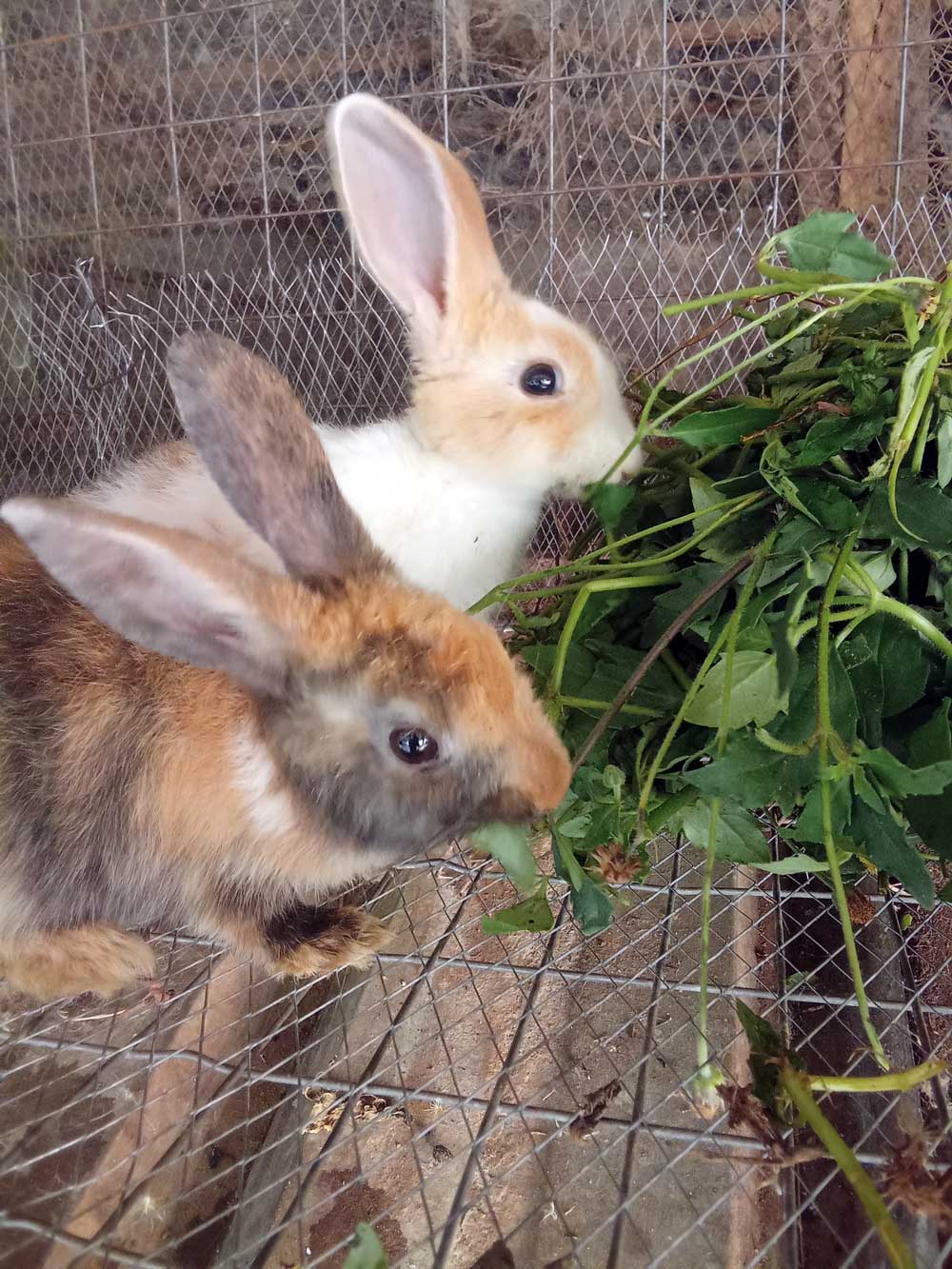
Fresh forage + good hay + appropriate pellets/concentrate + clean water.
The exact quantity of each depends on several factors.
A growing rabbit has different nutritional needs from a lactating doe. A mature breeding buck does not need the same feeding programme as a doe nursing a large litter.
Weather also matters.
During the rainy season, you may have abundant fresh forage. During the dry season, hay and purchased feed may become more important.
Farm size matters too. A farmer keeping five rabbits can manage feeding differently from someone keeping 100 or more.
Don’t Forget Water
Sometimes farmers spend money thinking about feed but treat water as an afterthought.
That is a mistake.
Clean drinking water should be available to rabbits every day.
A rabbit eating dry hay and pellets particularly needs reliable access to water.
Use clean drinkers and check them regularly. In hot weather, water consumption can increase, and drinkers can become dirty quickly.
A blocked or empty drinker can affect rabbits much faster than many farmers realize.
Related articles:
Caring For Goats during the Raining Season, Best Strategy to Employ.
5 Proven Dry-Season Cow Fattening Secrets Every Smart Farmer Uses to Get Quick, Excellent Results
Grass-Fed vs. Grain-Fed: Uncover the Best for Your Cows!
Common Rabbit Feeding Mistakes
- Changing feed suddenly
Rabbits have sensitive digestive systems.
If you suddenly replace one feed with another, digestive upset can occur.
When introducing a new forage or concentrate, make the change gradually and observe the animals.
- Feeding mouldy forage
If hay smells musty, looks mouldy or has clearly spoiled, don’t try to save money by feeding it.
The cost of replacing bad feed is much smaller than dealing with sick or dying rabbits.
- Giving too many treats
Vegetables and leafy materials can be useful, but constantly adding different foods simply because rabbits enjoy them is not good feeding management.
Keep the diet consistent and balanced.
- Depending entirely on expensive pellets
Pellets are useful, but depending completely on purchased feed can make a small rabbit farm expensive to operate.
Where safe forage is available, learn how to use and preserve it properly.
- Ignoring the rabbit’s condition
Don’t feed every rabbit exactly the same way simply because they live in the same cage block.
Look at their body condition, growth, reproductive stage and general health.
A thin doe with a large litter has different nutritional demands from a mature buck that is not breeding frequently.
Feeding for Better Breeding
Good feeding directly supports reproductive performance.
A doe that is underfed may struggle to maintain good body condition, raise a large litter or recover properly after kindling.
On the other hand, excessive feeding can also lead to unnecessary feed costs and obesity.
The aim is good body condition—not simply a fat rabbit.
Pregnant and nursing does deserve particular attention because their nutritional demands increase.
After kindling, a doe producing milk needs adequate nutrients and water to support both herself and her kits.
This is one reason why a farmer should not treat the breeding herd exactly like rabbits being raised for meat.
How Good Feeding Improves Profit
Let’s talk about the part every farmer understands: money.
Feed is usually one of the major operating costs in livestock production. If you don’t control feed costs, profit can disappear quickly.
But cutting feed costs blindly is not the answer.
There is a difference between reducing waste and underfeeding animals.
For example, collecting suitable forage from your farm or nearby safe sources can reduce dependence on purchased feed. Making hay when forage is abundant can help during periods of scarcity.
At the same time, investing in a good-quality balanced concentrate for rabbits that genuinely need it can support growth and reproduction.
The target should be:
Good nutrition + low wastage + healthy rabbits + predictable growth = better farm economics.
A Simple Feeding Routine for Small Farmers
You don’t need a complicated feeding chart to start.
A simple routine could look like this:
Morning: Check water, provide appropriate forage and observe the rabbits.
Afternoon: Check the cages, remove spoiled or uneaten material and provide additional forage or hay where needed.
Evening: Provide the appropriate concentrate/pellets according to the rabbit’s production stage and feeding programme.
But don’t follow this blindly.
Your rabbits’ needs may differ according to breed, age, climate, housing system and production objective.
Most importantly, observe your animals.
Their appetite, droppings, body condition, growth and general behaviour tell you a lot about whether your feeding programme is working.
CONCLUSION
Rabbit feeding doesn’t have to be expensive or complicated.
For many small– and medium-scale farmers, fresh, safe forage, quality hay, and properly used pellets or balanced concentrate can form the foundation of a practical feeding programme.
The real skill is learning how to balance these feeds, reduce waste, preserve forage when it is abundant, provide enough clean water and adjust feeding according to the rabbit’s stage of production.
Don’t chase the cheapest feed.
Chase good nutrition at the lowest sensible cost.
That is where good rabbit farming begins.
Takeaway
Feed your rabbits right, watch their condition, control waste and keep their diet consistent. Healthy rabbits grow better, breed better and give the farmer a better chance of making money.
Which three feeds have worked best for your rabbits, and which one has reduced your feeding costs the most? Share your experience below.